
Wall Pack Lights: How to Choose the Right One for Your Building
A few years ago, a property manager called us with a problem. He managed three warehouse buildings, and every winter his maintenance crew was replacing burned-out metal halide wall packs — sometimes twice a season. The fixtures were 20 feet up, so every replacement meant renting a lift, scheduling an electrician, and paying for the downtime.
He wasn't asking for the cheapest fixture. He was asking for the right one.
That's what this guide is about. Not "which wall pack is cheapest," but "which wall pack actually solves your problem." Because the answer depends on where you're mounting it, what you're lighting, and what you need it to do when things go wrong.
First, What Is a Wall Pack — and When Should You Use One?
A wall pack is a light fixture that mounts directly to a wall and throws light outward and downward. It's one of the oldest and most reliable forms of outdoor lighting, and it's still the go-to choice for:
- Building perimeters and facades
- Entryways and exit doors
- Parking areas and loading docks
- Warehouse and industrial exteriors
- School, hospital, and campus walkways
But not every wall pack is right for every job. The wrong choice means either too much light (wasting energy and annoying neighbors), too little light (creating safety hazards), or the wrong color (making a space feel harsh or dim).
The Five Questions You Should Ask Before Buying
1. How high will it be mounted?
Mounting height determines everything else. A wall pack mounted at 8 feet needs very different output than one mounted at 25 feet.
| Mounting Height | Recommended Wattage | Best For |
|---|---|---|
| 6–10 ft | 20W–40W | Entryways, small doors |
| 10–15 ft | 60W–100W | Commercial walls, sidewalks |
| 15–25 ft | 100W–150W | Warehouse exteriors, parking |
| 25+ ft | 150W+ | Industrial perimeters, large lots |
Mounting too low with too much wattage creates glare and light trespass. Mounting too high with too little wattage leaves dark spots — a security risk.
2. What color temperature do you actually need?
This is the one most people get wrong. Color temperature (measured in Kelvin) changes how a space feels and how well people can see.
- 3000K (Warm White): Residential, hospitality. Feels welcoming.
- 4000K (Neutral White): Commercial, mixed-use. Balanced and comfortable.
- 5000K (Cool White): Security, parking, industrial. Crisp and alert.
- 5700K (Daylight): Maximum visibility. Best for high-security areas.
If you're lighting a parking lot or a warehouse perimeter, 5000K or 5700K is almost always the right answer. If you're lighting a residential entryway, 3000K or 4000K will feel much more natural.
3. Do you need a photocell, motion sensor, or both?
A photocell turns the light on at dusk and off at dawn. A motion sensor turns it on only when movement is detected. Both save energy — but they solve different problems.
- Photocell: Best for security lighting that needs to stay on all night.
- Motion sensor: Best for areas with low foot traffic and high energy costs.
- Both: Ideal for loading docks and side entrances — light only when needed.
4. What happens when the power goes out?
This is the question most buyers forget — until it matters. In a power outage, standard wall packs go dark. If that wall pack is lighting an exit path, a stairwell, or a loading area, darkness isn't just inconvenient — it's a safety hazard.
That's where emergency battery backup comes in. A wall pack with integrated backup keeps running for 90+ minutes during an outage, meeting most building code requirements for egress lighting.
5. How much maintenance are you willing to do?
Metal halide and HID wall packs need new lamps every 1–2 years. LED wall packs last 50,000–100,000 hours — that's 10 to 20 years of typical operation. If your fixtures are mounted high, the labor savings alone can pay for the upgrade.
The rule of thumb: If you're replacing lamps more than once a year, you're not saving money on cheap fixtures — you're paying for them in labor.
What "Selectable" Means — and Why It Matters
Here's something that's changed the wall pack market in the last few years: selectable fixtures.
Instead of buying a fixed 100W wall pack in 5000K, you buy a fixture with built-in selector switches. During installation, you choose the wattage and color temperature that match the job.
That means one SKU can cover multiple projects. You don't need to stock three different wattages and two different color temperatures — you stock one box.
For contractors, facility managers, and distributors, that's a real advantage. It reduces inventory, reduces mistakes, and makes it easier to standardize on one fixture across an entire property.
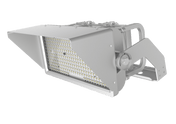
HYLELE 120W Wall Pack Light with Emergency Backup
Our 120W wall pack combines 3-wattage selectable output (80W/100W/120W), 3-color selectable CCT (4000K/5000K/5700K), an integrated emergency battery backup, and a built-in dusk-to-dawn photocell — all in one IP66-rated fixture. At 130 lm/W, it delivers up to 15,600 lumens while using up to 70% less energy than metal halide.
View Product →How to Match the Right Wall Pack to the Right Space
Here's a quick reference based on real-world applications:
| Space | Recommended Setup |
|---|---|
| Residential driveway | 80W, 4000K, photocell |
| Commercial entryway | 80–100W, 4000K, photocell |
| Parking lot perimeter | 100–120W, 5000K, photocell |
| Warehouse exterior | 120W, 5000K, photocell |
| Industrial perimeter (security) | 120W, 5700K, photocell |
| Emergency egress path | 100W, 5000K, battery backup |
Installation Mistakes to Avoid
- Mounting too low: Creates glare and light trespass. Follow the height table above.
- Using the wrong color temperature: 5700K in a residential area feels harsh. 4000K in a parking lot may feel dim.
- Forgetting the photocell: Manual switches get left on. Photocells don't.
- Skipping the emergency backup: It's the one feature you'll wish you had when the power goes out.
- Not sealing conduit entries: Even an IP66 fixture can fail if water gets in through unsealed openings.
Frequently Asked Questions
Do I need an electrician to install a wall pack?
For standard 120V residential installations, a competent DIYer can often handle it. For commercial 277V or 347V installations, hire a licensed electrician.
Can I use a wall pack indoors?
You can, but it's not ideal. Wall packs are designed for outdoor throw patterns. For indoor high-bay or low-bay lighting, a dedicated indoor fixture will perform better.
How long do LED wall packs last?
Most quality LED wall packs are rated for 50,000 to 100,000 hours. At 12 hours per night, that's 11 to 22 years of operation.
What's the difference between IP65 and IP66?
Both are waterproof, but IP66 is protected against powerful water jets — not just splashes. For coastal areas, washdown environments, or heavy rain, IP66 is the safer choice.
The Bottom Line
Choosing a wall pack isn't about finding the cheapest fixture. It's about finding the one that fits your mounting height, your lighting needs, your climate, and your maintenance budget.
If you're replacing old metal halide fixtures, upgrading to LED is almost always worth it — not just for energy savings, but for the labor savings alone. And if you're specifying new lighting, a selectable wall pack with emergency backup gives you the flexibility to handle multiple applications with one product.
If you're not sure which wall pack is right for your project, we're happy to help. Send us a message and we'll walk you through it.