
For stadium owners, sports facility managers, and athletic directors, determining the right amount of light for a sports venue is one of the most critical decisions affecting player performance, spectator experience, broadcast quality, and operational costs. Too few lumens, and the lighting will be dim and uneven—making it difficult for players to perform effectively and for spectators to enjoy the game . Too many lumens, and you risk excessive brightness, glare, light pollution, and wasted energy .
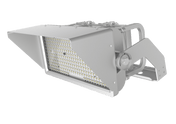
Hylele, a global leader in advanced LED lighting solutions, has engineered the SP02 series LED sport lights to deliver the precise illumination that modern sports facilities demand . With industry-leading efficacy up to 160 lumens per watt, smart control compatibility, and rugged durability, Hylele's solutions help facility managers calculate and achieve the exact lumen output needed for their specific application . But how many lumens do you actually need? This comprehensive guide walks you through everything you need to know to determine the perfect lumen package for your sports venue.
1. Understanding Lumens vs. Lux: The Foundation of Sports Lighting
Before diving into calculations, it's essential to understand the difference between lumens and lux—two concepts that are both critical for sports lighting.
What Are Lumens?
A lumen (lm) is the total amount of visible light emitted from a light source . In stadium lighting, it refers to the total illumination produced by the lighting system . Think of lumens as the total "light budget" your fixtures provide.
What Is Lux?
A lux (lx) is a unit of measurement of light intensity, referring to illumination on a surface . One lux equals one lumen per square meter . Lux represents both the total amount of light and its intensity on the playing field.
The Critical Relationship
The difference between lumens and lux is that lux takes into account the area over which the luminous flux is spread .
-
If 1000 lumens are concentrated into an area of 1 square meter, the illuminance is 1000 lux .
-
If the same 1000 lumens are spread over 10 square meters, the illuminance is only 100 lux .
Key Takeaway: For sports lighting, you need to know both the total lumens required AND the lux level needed at the playing surface. A focused beam of light will provide more illumination (higher lux) even if the total lumens remain constant .
The Calculation Formula
Total Lumens Needed = Target Lux × Area (m²)
For example, if you have a stadium of 100 square meters area and the needed lux is 300 lux, the required lumens will be 30,000 lumens .
2. Standard Lux Requirements by Sport and Level
Different sports and competition levels have different illuminance requirements, typically set by international governing bodies .
General Lux Requirements by Venue Level
Football/Soccer Field
Dimensions: 64m × 100m (6,400 m²)
Tennis Court
Single Match Dimensions: 8.23m × 10.97m (90.3 m²)
Double Match Dimensions: 10.97m × 23.77m (260.8 m²)
*Note: The value for international events appears to be an anomaly in the source; typical professional tennis would be 500-750 lux.*
Basketball Court
Dimensions: 28m × 15m (420 m²)
| Purpose | Lux Requirements | Total Lumens Needed |
|---|---|---|
| Recreational and training activities | 200 lux | ≥84,200 lumens |
| NBA and FIBA World Cup competitions | 2000 lux | ≥840,000 lumens |
Hockey Field
Dimensions: 55m × 91.4m (5,027 m²)
Volleyball Court
| Purpose | Lux Requirements | Total Lumens Needed |
|---|---|---|
| Recreational and training activities | 75-200 lux | ≥12,150-32,400 lumens |
| National and international games | 500 lux | ≥81,000 lumens |
3. Generic Field for Multi-Purpose Use
For a generic field that can be used for any sports event (64m × 100m = 6,400 m²) :
4. The Hylele SP02 Advantage
Hylele's SP02 series LED sport lights are engineered to deliver the precise illumination required for professional sports venues .
Key Specifications
Calculating Fixture Count with Hylele SP02
If using Hylele SP02 1500W fixtures (1500W × 160 lm/W = 240,000 lumens per fixture), you can calculate the number of fixtures needed:
Example for Professional Football Field (6,400,000 lumens needed):
-
Number of fixtures = 6,400,000 ÷ 240,000 = 27 fixtures
This is a simplified calculation. Actual requirements depend on mounting height, beam angles, and uniformity requirements.
Application Recommendations
5. Factors That Affect Lumen Requirements
Beyond the basic area and lux calculation, several other factors influence the actual lumen output needed.
A. Mounting Height and Beam Angle
The beam angle of sport lights determines how light is distributed :
Narrow beams are essential for punching light down from high mounting heights (25-45 meters) while maintaining intensity at the playing surface.
B. Uniformity Requirements
The illuminance uniformity should be maintained within ±20% to avoid visual disturbances caused by uneven lighting . Key uniformity metrics:
-
U1 (minimum to maximum): Should be ≥0.6-0.7 for professional venues
-
U2 (minimum to average): Should be ≥0.7-0.8 for professional venues
Hylele's precision optical lenses minimize glare, eliminate shadows, and ensure consistent lighting across the entire field .
C. Glare Control
Glare can severely interfere with the vision of athletes and spectators . For professional venues:
Hylele's advanced optical design and anti-glare technology reduce spill light and glare, complying with FIFA and EN12193 standards .
D. Color Rendering Index (CRI)
CRI measures the ability of a light source to reproduce true colors .
| CRI Level | Application |
|---|---|
| 80-85 | General sports lighting |
| 90-95+ | Broadcast-quality lighting, figure skating, gymnastics |
Hylele SP02 fixtures feature CRI above 80 with adjustable color temperatures (3000K-6500K), delivering natural color reproduction essential for professional sports broadcasts .
6. The Hylele Advantage: Performance You Can Trust
Hylele's SP02 series delivers exceptional performance across all critical metrics :
Comparison: Traditional Metal Halide vs. Hylele SP02 LED
Energy Savings in Practice
A case study from a community football field in China demonstrated the real-world impact of LED conversion :
| Indicator | Before (8×1000W MH) | After (12×180W LED) | Improvement |
|---|---|---|---|
| Total Power | 8000W | 2160W | -73% |
| Annual Electricity | 14,400 kWh | 3,888 kWh | -73% |
| Illumination | 220 lux | 280 lux | +27% |
| Maintenance Cost | 2,400元/year | 200元/year | -92% |
7. Step-by-Step Lumen Calculation Guide
Step 1: Identify Your Sport and Level
Determine the sport(s) your venue hosts and the competition level (recreational, club, professional, broadcast).
Step 2: Determine Lux Requirement
Use the tables above to find the required lux for your sport and level.
Step 3: Measure Your Field Area
Calculate the exact dimensions of your playing surface in square meters.
Step 4: Calculate Total Lumens Needed
Total Lumens = Lux Requirement × Area (m²)
Step 5: Account for Maintenance Factor
LED fixtures gradually lose brightness over time. Use a maintenance factor of 0.8 to ensure adequate light at end of life.
Adjusted Lumens = Total Lumens ÷ 0.8
Step 6: Determine Fixture Count
Divide adjusted lumens by the lumen output per fixture (Hylele SP02 delivers up to 240,000 lumens at 1500W).
Step 7: Verify with Photometric Analysis
For guaranteed results, request a professional photometric analysis from Hylele's technical team. This will confirm:
-
Exact fixture count needed
-
Optimal placement and spacing
-
Achieved lux levels and uniformity ratios
-
Glare control compliance
8. Frequently Asked Questions
Q: What's the difference between lumens and lux in stadium lighting?
A: Lumens measure total light output from fixtures. Lux measures light intensity on the playing surface (1 lux = 1 lumen per square meter). Both are essential for proper sports lighting design .
Q: How many lumens does a football stadium need?
A: For a standard 64m × 100m football field, recreational use requires ≥480,000 lumens, club level requires ≥1,280,000 lumens, and international broadcast events require ≥6,400,000 lumens .
Q: How many lumens does a tennis court need?
A: For a double tennis court (10.97m × 23.77m), recreational use requires ≥65,200 lumens, club level requires ≥91,300 lumens, and international events require higher levels .
Q: What happens if a stadium has too few or too many lumens?
A: Too few lumens results in dim, uneven lighting that impairs player performance and viewing experience. Too many lumens causes excessive brightness, glare, light pollution, and wasted energy .
Q: What beam angle is best for sports lighting?
A: Narrow beams (10-30°) are best for long-distance illumination from tall masts; wider beams (60-120°) are suitable for areas closer to the light source .
Q: How do I calculate lumens from wattage?
A: Use the formula: Lumens = Watts × Efficacy (lm/W). For Hylele SP02 with 160 lm/W efficacy, a 1000W fixture delivers 160,000 lumens .
Q: What CRI do I need for broadcast sports?
A: For professional broadcasts, CRI of 90 or above is recommended. Hylele SP02 offers CRI >80 with options for higher .
Q: How long do LED sport lights last?
A: Hylele SP02 fixtures are rated for over 100,000 hours—more than 22 years at 12 hours per day .
Q: Do LED sport lights work in cold weather?
A: Yes. Hylele SP02 fixtures operate reliably from -40°C to +55°C, making them suitable for any climate .
Q: How much energy can I save with LED sport lights?
A: Compared to traditional metal halide systems, Hylele SP02 reduces energy consumption by up to 70% .
9. Beyond Lumens: Other Critical Specifications
While lumens are fundamental, complete sports lighting design requires consideration of:
Hylele SP02 fixtures deliver on all these fronts with precision-engineered optics, IP66 protection, and smart control compatibility (DALI/DMX512/0-10V dimming) .
Conclusion: Getting the Lumens Right for Your Sports Venue
Determining how many lumens you need for LED sport lights requires careful consideration of your sport type, competition level, field dimensions, and quality requirements. Hylele's SP02 series delivers the precise illumination that modern sports facilities demand, with:
-
100,000-hour lifespan minimizing maintenance for over two decades
-
Precision optics with multiple beam angles for perfect light control
-
Smart control compatibility for adaptive, multi-purpose venues
By following the guidelines in this article, you can confidently calculate the right lumen package for your facility and select the optimal Hylele sport lights for your specific application.
As the global sports industry moves toward smarter, greener designs, Hylele ensures every game, every performance, and every audience moment shines brighter than ever .