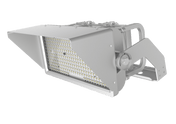

LED stadium lights have become the gold standard for sports venues, from community soccer fields to professional arenas, thanks to their superior energy efficiency, precise light control, and ability to meet international broadcast standards. Unlike traditional metal halide lights—which suffer from long warm-up times, high energy consumption, and poor glare management—modern LED stadium lights deliver instant, uniform illumination that enhances athlete performance, spectator experience, and HD broadcast quality. But with varying event levels, venue sizes, and technical requirements, selecting the right LED stadium lights can be complex. This guide breaks down the critical factors to consider, backed by 2026 industry standards and real-world case studies, to help you make a data-driven decision.
1. Match Illuminance (Lux) to Your Venue’s Purpose & Event Level
Illuminance (measured in lux, lx) is the foundation of stadium lighting—too little light risks safety, while too much wastes energy and causes glare. The required lux depends on your facility’s use (training vs. competition) and whether it hosts HD/4K broadcasts. Follow these industry standards (aligned with JGJ 153-2016 and FIFA/UEFA guidelines) :
|
Venue Type
|
Event Level
|
Horizontal Illuminance (lx)
|
Vertical Illuminance (lx)
|
Uniformity (U1/U2)
|
|
Community Fields (Soccer/Basketball)
|
Amateur/Training
|
200–500
|
100–250
|
≥0.6
|
|
School/College Stadiums
|
Competitive (Non-Broadcast)
|
500–1000
|
300–600
|
≥0.7
|
|
Professional Arenas
|
National Broadcast
|
1000–1400
|
800–1200
|
≥0.8
|
|
International Stadiums
|
HD/4K Broadcast
|
1400–2000
|
1200–1600
|
≥0.9
|
Key notes:
- Vertical Illuminance: Critical for broadcasts—cameras require sufficient light on athletes’ faces and bodies (measured 1.5m above ground) to capture details without shadows.
- Uniformity: The ratio of minimum to average lux (U1) and minimum to maximum lux (U2) ensures no dark spots or hot zones. For example, a professional soccer stadium with U1≥0.8 means the darkest area receives at least 80% of the average light.
- Real-World Example: China’s Jiangsu Rugao Olympic Sports Center, home to a Chinese Super League team, uses 270 units of 1500W LED stadium lights to achieve 1800+ lx horizontal illuminance and 0.90 uniformity—meeting FIFA broadcast standards for international matches .
2. Prioritize Glare Control & Anti-Light Pollution
Glare is a major issue in sports lighting, as it can blind athletes (e.g., a soccer goalkeeper tracking a high ball) and irritate spectators. LED stadium lights solve this with advanced optical design, but you need to focus on two key metrics:
- Glare Rating (GR): Must be ≤35 for most sports venues, per JGJ 153-2016 . For high-brightness arenas (e.g., basketball, volleyball), aim for GR≤30 to eliminate "blinding" effects. Look for fixtures with deep anti-glare hoods and non-symmetrical 配光 (light distribution) to direct light downward.
- Light Spill: Use TIR (Total Internal Reflection) optics with ≥90% light utilization to prevent light from spilling into surrounding neighborhoods or roadways—avoiding light pollution complaints and compliance issues. A common mistake: installing fixtures with wide beam angles (≥60°) on tall poles (16m+), which wastes 20-30% of light on non-target areas.
3. Select the Right Power, Beam Angle & Pole Configuration
LED stadium light power (100W–2000W) and beam angle (15°–60°) must align with your venue’s size and pole height. Use this practical guide :
|
Venue Type
|
Pole Height
|
Fixture Power
|
Beam Angle
|
Number of Poles
|
|
5-A-Side Soccer Field (40x20m)
|
8–12m
|
300–500W
|
45°–60°
|
4–6
|
|
Full-Size Soccer Field (100x60m)
|
16–25m
|
1000–1500W
|
25°–45°
|
6–8
|
|
Indoor Basketball Arena (28x15m)
|
10–15m
|
500–800W
|
30°–45°
|
8–12
|
|
Tennis Court (23.77x10.97m)
|
6–8m
|
200–400W
|
45°–60°
|
6–8
|
- Beam Angle Tip: Taller poles (16m+) require narrower beam angles (25°–35°) to concentrate light on the field, while shorter poles (8–12m) need wider angles (45°–60°) for uniform coverage.
- Pole Type: For large outdoor stadiums, use high 杆灯塔 (high-mast poles, 20–30m) with integrated 防雷系统 (lightning protection) and 检修爬梯 (maintenance ladders). For small venues, foldable or mobile poles offer flexibility for temporary events.
4. Ensure Broadcast-Quality Light: CRI, CCT & Flicker-Free Operation
If your venue hosts televised events, three additional factors are non-negotiable:
- Color Rendering Index (CRI): Ra≥90 (general) and R9≥70 (red color rendering) ensure accurate color representation—critical for distinguishing team uniforms and capturing natural skin tones on camera. A common failure: low-R9 LEDs (R9 color distortion in broadcasts, making red jerseys appear dull .
- Correlated Color Temperature (CCT): 5000K (daylight white) is the standard for most sports, as it mimics natural light and reduces eye fatigue. For indoor arenas, 4000K–5000K is ideal (balanced warmth and clarity), while outdoor stadiums can use 5000K–6500K for enhanced visibility in low-light conditions.
- Flicker-Free Performance: Flicker percentage must be % (per IEC 60598-2-3 standards) to avoid strobing effects in HD/4K broadcasts. Choose LEDs with high-frequency drivers (≥1000Hz) to eliminate flicker—even at dimming levels .
5. Prioritize Durability & Environmental Adaptability
Stadium lights face harsh conditions (rain, wind, extreme temperatures), so durability is key:
- IP Rating: Minimum IP65 for outdoor venues (dust-tight and protected against low-pressure water jets). For coastal or humid environments, opt for IP66 with 96-hour salt spray resistance to prevent corrosion .
- Construction: Look for fixtures made of ADC12 die-cast aluminum with electrostatic powder coating—this material resists rust and withstands wind loads up to 150km/h (critical for high-mast installations).
- Operating Temperature: Ensure the lights work reliably in -30°C to +50°C environments—LEDs perform better than metal halides in extreme cold, with no warm-up time needed.
6. Invest in Smart Lighting Controls for Flexibility & Savings
Modern LED stadium lights support intelligent control systems that boost operational efficiency and adapt to different scenarios:
- Scene Modes: One-click switching between training (500lx), competition (1000lx), and broadcast (1400lx) modes—saving 30-50% energy during non-peak use. For example, a community stadium can dim lights to 200lx for youth practices and brighten to 1000lx for high school games.
- IoT Connectivity: Cloud-based platforms let you monitor energy use, schedule lighting, and receive maintenance alerts remotely. Some systems integrate with crowd density sensors to adjust brightness in real time—reducing energy use by 40% during low-attendance events .
- Entertainment Features: RGBW color mixing supports light shows for halftime performances or post-game celebrations, enhancing spectator engagement.
7. Calculate Total Cost of Ownership (TCO) & ROI
While LED stadium lights have higher upfront costs (\(500–\)5,000 per fixture) than metal halide, their TCO is far lower. Use this formula to estimate savings:
Annual Savings = (Traditional Wattage – LED Wattage) × Hours Used × $/kWh + Maintenance Cost Savings
Example: A 10-pole soccer field replacing 1000W metal halides (10 fixtures) with 600W LEDs (10 fixtures), used 10 hours/day, 300 days/year, at $0.15/kWh:
- Energy Savings: (10,000W – 6,000W) × 3,000h × \(0.15/kWh = \)1,800/year.
- Maintenance Savings: Metal halides need replacement every 2 years (\(500/fixture + labor) vs. LEDs (50,000-hour lifespan) = \)2,500/year.
- Total Annual Savings: \(4,300—ROI achieved in 2.3 years (assuming \)10,000 upfront cost).
Additional incentives: Many regions offer rebates for energy-efficient stadium lighting—up to $50 per fixture for DLC-certified models .
8. Verify Certifications & Supplier Expertise
To avoid subpar products, prioritize LEDs with these certifications:
- Safety: IEC 60598-2-3 (stadium light-specific), UL, CE.
- Energy Efficiency: DLC Premium, ENERGY STAR.
- Environmental: RoHS (no mercury/lead).
Choose suppliers with experience in sports lighting—preferably those who have worked on professional or international events (e.g., World Cup qualifiers, university championships). Ask for photometric reports (DIALux evo simulations) to verify lux levels, uniformity, and glare control before purchase.
Conclusion: Invest in LED Stadium Lights That Grow With Your Venue
Choosing the right LED stadium lights requires balancing technical specs (lux, glare, CRI) with your venue’s purpose, budget, and long-term goals. By focusing on illuminance matching, glare control, broadcast compatibility, and smart features, you’ll select a system that enhances athlete performance, delights spectators, and delivers significant energy savings.
With 2026 models offering higher efficacy (up to 180 lm/W), longer warranties (5–10 years), and seamless smart integration, there’s never been a better time to upgrade. Whether you’re outfitting a community field or a professional arena, prioritize quality over upfront cost—investing in premium LED stadium lights ensures reliability, compliance, and ROI for years to come.
Ready to get started? Consult a lighting designer for a custom photometric plan, and request on-site demos to test glare and uniformity before full installation.