
Determining the exact number of LED stadium lights needed for a football field can feel like a complex equation with many variables. The simple truth is that there is no single answer; the precise quantity depends on a range of factors, from the level of competition to the specific hardware chosen.
This guide provides a clear, step-by-step methodology to cut through the confusion. We will break down the key factors influencing your decision, walk through a practical calculation formula, analyze real-world case studies, and lay out a final checklist for success.
1. Key Factors That Determine How Many Lights You Need
Before you can start any calculation, you must clarify the specific requirements of your project. Four primary factors will dictate the final number of fixtures:
-
Level of Play & Lux Requirements: These are the most critical factors. The illuminance (measured in lux) required for a community training field is vastly different from that required for a professional stadium hosting HD broadcasts. Training and recreational play typically need 200–300 lux, amateur club matches may require 300–500 lux, professional matches are best served by 500–1000 lux, and broadcast or international-level events demand 1000–2000 lux. This requirement directly determines the total luminous flux (lumens) needed to light the entire field.
-
Field Size: Whether you are lighting a small 5-a-side pitch or a full-sized professional field (typically around 105 x 68 meters) obviously affects total lighting needs.
-
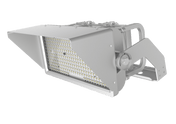
Fixture Wattage and Efficacy: The power and efficiency of the luminaires you choose matter greatly. The simplest method for selecting the right LED lights is to use a wattage-to-wattage replacement ratio. As a robust industry benchmark, a modern 600W LED stadium light can effectively replace and outperform a legacy 1500W metal halide lamp, reducing total grid energy demand by 60% or more.
-
Beam Angle and Placement: The beam angle of a fixture (narrow 15°–45° versus wide 90°–120°) determines how light is spread. Narrow beams project light farther for tall mounting poles, while medium or wide beams provide more uniform coverage for lower mounting heights.
2. How To Calculate the Number of Fixtures
Imagine you have a professional football field measuring 105 x 68 meters (approx. 7,140 m²). The competition level requires a standard broadcast-level illuminance of 1,400 lux on the playing surface. Here is the calculation process.
Step 1: Determine the Total Lumen Output Needed
The basic formula is Area (m²) × Lux Level = Total Lumens Needed. However, seasoned engineers apply a multiplier (Light Loss Factor, LLF) to account for real-world light depreciation over time.
A conservative LLF is 1.3. This factor includes lumen depreciation (L70) and expected dust/dirt accumulation on the fixtures over the years of operation.
Here is the calculation:
Total Lumens = Field Area × Lux Level × LLF
Total Lumens = 7,140 m² × 1,400 lux × 1.3 = approximately 13,000,000 lumens
Step 2: Determine the Lumen Output per Fixture
For this professional-level example, you might select a high-efficiency 1,500W LED stadium light. With a modern efficacy of 160 lm/W, such a fixture would emit approximately 240,000 lumens.
Step 3: Calculate the Number of Fixtures
Divide the total lumens needed by the lumens per fixture:
Number of Fixtures = 13,000,000 lumens / 240,000 lumens per fixture
Number of Fixtures = approx. 54 fixtures
So, for a top-tier broadcast football field, you would likely need around 50 to 60 high-power LED luminaires.
3. Real-World Case Study: Chinese Super League
A powerful, modern application of this calculation is found at the Jiangsu Rugao Olympic Sports Center, a venue for the Chinese Super League. The facility uses 270 units of 1,500W LED stadium lights to achieve an impressive average horizontal illuminance of over 1,800 lux with a uniformity of 0.90. This successful installation is a testament to the high standards of modern LED technology for professional and broadcast-level football.
4. What Additional Factors Should You Consider?
The wattage-to-wattage replacement model is effective, but for an optimal design, also consider:
-
Color Quality (CRI & CCT): For broadcast sports, you should specify a Color Rendering Index (CRI) of at least 80, and a Correlated Color Temperature (CCT) of 5000K–6000K to replicate daylight conditions and provide true-to-life colors for cameras.
-
Pole Height: Taller poles generally require fixtures with narrower beams to project the light onto the field. This can influence the final number of fixtures needed and their placement around the perimeter.
-
Smart Control and Dimming: Newer stadium lighting designs frequently incorporate smart controls (e.g., DALI or DMX). These systems allow zoning and dimming lighting for different events, which can reduce the total required upfront fixtures by maximizing their usage efficiency.
Conclusion: A Complete Comparison of Lighting Levels
To help you benchmark your potential needs, here is a summary comparison of LED fixture requirements based on the level of play:
| Parameter | Recreational / Training | Amateur / Club Match | Professional / Broadcast |
|---|---|---|---|
| Avg. Lux Level (Target) | 200 – 300 lux | 300 – 500 lux | 1,000 – 2,000 lux |
| Typical LED Wattage | 240W – 400W LED | 400W – 800W LED | 1000W – 1500W LED |
| Example Fixture Quantity (Full Field) | 24 – 28 units (1000W equivalent) | 30 – 40 units | ~50 – 60+ units |
| Typical Beam Angle | 90° – 120° (Wide) | 90° – 110° (Medium/Wide) | 15° – 60° (Narrow/Medium) |
| Typical Pole Height | 15 – 20 meters | 20 – 30 meters | 30 – 45+ meters |
For specialized lighting layouts of your field, it is always best to request a professional photometric lighting plan. This simulation will provide you with the most accurate number of fixtures, an exact placement map, and total project cost.