
Introduction
When it comes to lighting the exterior of commercial buildings – loading docks, alleyways, building perimeters, and parking lot edges – two technologies dominate the conversation: LED wall pack lights and traditional HID fixtures (metal halide and high‑pressure sodium). For decades, HID wall packs were the standard. They were rugged, bright, and familiar. But in 2026, LED wall packs have matured into a superior solution across almost every metric – energy efficiency, light quality, lifespan, maintenance, and smart controls.
If you are a facility manager, building owner, or electrical contractor, you face a critical decision: stick with HID or upgrade to LED. This guide provides a comprehensive, head‑to‑head comparison between LED wall pack lights and traditional HID wall packs (metal halide and HPS). We’ll examine energy consumption, lumen output, color rendering (CRI), start‑up time, motion sensor compatibility, maintenance costs, environmental impact, and total cost of ownership (TCO). By the end, you’ll have clear data to make the right choice for your commercial property.
What Are Wall Pack Lights?
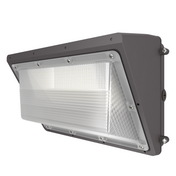
Wall pack lights are surface‑mounted luminaids attached to building exteriors. They provide downward and outward illumination for security, safety, and aesthetics. Typical applications include:
-
Building perimeters
-
Entryways and exit doors
-
Loading docks and service areas
-
Dumpster enclosures
-
Alleyways and walkways
-
Parking garage exteriors
Both LED and HID wall packs serve these purposes, but they achieve the task in fundamentally different ways.
The Contenders: LED Wall Packs vs. HID Wall Packs
| Feature | LED Wall Pack | Metal Halide Wall Pack | High‑Pressure Sodium Wall Pack |
|---|---|---|---|
| Typical wattage | 20W – 150W | 70W – 400W | 50W – 250W |
| Luminous efficacy | 120 – 180+ lm/W | 65 – 100 lm/W | 80 – 130 lm/W |
| Typical lumens (for 80W equivalent) | ~12,000 lm | ~8,000 lm | ~10,000 lm |
| Color Rendering Index (CRI) | 80 – 95+ | 65 – 75 (degrades) | 20 – 25 (very poor) |
| Color temperature (CCT) | Selectable (3000K – 6500K) | Fixed (3000K – 4200K, shifts) | Fixed (1900K – 2200K, orange) |
| Start‑up time | Instant (<0.5 sec) | 3 – 10 min warm‑up | 3 – 5 min warm‑up |
| Restrike after power loss | Instant | 10 – 15 min cool‑down | 1 – 2 min |
| Dimming / smart controls | Yes (0‑10V, DALI, wireless) | Very limited / expensive | Very limited / expensive |
| Motion sensor compatibility | Excellent (instant response) | Poor (warm‑up delay) | Poor |
| Lifespan (L70) | 50,000 – 100,000+ hours | 10,000 – 20,000 hours | 24,000 – 40,000 hours |
| Lumen maintenance at 50,000h | >90% | <50% (lamp dead) | <60% |
| Heat emission | Low – efficient heat sink | Very high (surface >200°C) | High |
| UV / IR radiation | None | Emits UV and IR | Emits IR |
| Hazardous materials | None (RoHS compliant) | Contains mercury | Contains mercury + sodium |
| Maintenance frequency | Near‑zero (10+ years) | Relamp every 1‑2 years | Relamp every 2‑4 years |
| Typical payback period | 1 – 3 years (with rebates) | Not applicable | Not applicable |
Detailed Analysis: Why LED Wall Packs Outperform HID
1. Energy Efficiency – LED Uses 60‑80% Less Power
The most immediate benefit of LED wall packs is dramatically lower energy consumption. A typical 150W metal halide wall pack draws approximately 165‑180W (including ballast losses). A comparable LED wall pack delivering the same lumens uses only 30‑50W.
Example – 50‑fixture commercial building perimeter operating 4,000 hours/year at $0.12/kWh:
| Technology | Wattage per fixture | Total system wattage | Annual kWh | Annual energy cost |
|---|---|---|---|---|
| Metal Halide (150W MH) | 175W (incl. ballast) | 8,750W | 35,000 kWh | $4,200 |
| LED Wall Pack (50W equivalent) | 50W | 2,500W | 10,000 kWh | $1,200 |
| Annual savings | – | – | 25,000 kWh | $3,000 |
Over 10 years, energy savings alone exceed $30,000 – enough to pay for the LED upgrade multiple times.
2. Lifespan and Lumen Maintenance – LED Lasts 5‑10× Longer
HID lamps suffer from catastrophic lumen depreciation. By 50% of rated life (5,000‑10,000 hours), metal halide output drops to 50‑65% of initial. A wall pack that provided adequate security lighting when new becomes dangerously dim within two years – yet continues drawing full power.
LED wall packs maintain >90% of initial lumens for 50,000‑100,000 hours. At 12 hours per night (4,380 hours/year), that’s 11‑22 years of consistent, predictable light output. No gradual darkening, no surprise security gaps.
3. Light Quality – High CRI and Instant On
Color Rendering Index (CRI) is critical for security. Metal halide (CRI 65‑75) makes colors look washed out. High‑pressure sodium (CRI 20‑25) renders everything in monochromatic orange – impossible for security cameras to distinguish clothing colors, vehicle details, or faces.
LED wall packs offer CRI 80‑95+ , enabling accurate identification. Premium models reach CRI 90, which is recommended for CCTV applications.
Start‑up and restrike: HID wall packs require 3‑10 minutes to warm up. If a motion sensor triggers the light, the area remains dark during the critical initial seconds. After a power flicker, HID lamps need 10‑15 minutes to cool down before restarting – leaving your building perimeter completely dark. LED wall packs achieve full brightness instantly (<0.5 seconds) and restrike instantly.
4. Motion Sensor and Smart Control Compatibility
Modern LED wall packs are controls‑ready with standard 0‑10V dimming. This allows seamless integration with:
-
Passive infrared (PIR) or microwave motion sensors – lights run at 20‑30% dim during low‑activity hours, then instantly brighten to 100% upon motion detection. This startles intruders and saves energy.
-
Scheduling – automatically dim lights after midnight, then return to full output before employees arrive.
-
Remote monitoring – track fixture health, receive failure alerts, and log energy usage.
-
Integration with building management systems (BMS) – raise lights to 100% when an alarm is triggered.
HID wall packs cannot be dimmed efficiently. They are either on or off. Motion sensors for HID are ineffective because the lamp takes minutes to reach full brightness – the intruder has already passed.
5. Maintenance Costs – Near Zero for LED
HID wall packs require frequent maintenance:
-
Metal halide: Relamp every 12‑18 months (at 4,000 hours/year). Each lamp costs 40. Labor for a bucket truck or ladder is 150 per fixture.
-
Ballast replacement: Every 5‑8 years, add 100 per fixture.
-
Disposal: Mercury‑containing lamps must be handled as hazardous waste.
For a property with 50 wall packs, annual maintenance costs easily exceed 4,000.
LED wall packs have no lamps to replace. The driver and LEDs are rated for the life of the fixture. Maintenance drops to near zero – occasional lens cleaning only.
6. Environmental and Safety Benefits
-
No mercury – LED wall packs contain no hazardous materials. HID lamps contain 10‑50 mg of mercury each.
-
No UV radiation – LED emits no UV, so it won’t fade painted surfaces or signage.
-
Cool operation – LED wall packs run at low surface temperatures (50‑70°C / 120‑160°F), reducing fire risk and insect attraction. HID wall packs exceed 200°C (400°F).
-
Dark‑sky friendly – LED wall packs are available with full‑cutoff optics that direct light downward, minimizing light trespass and complying with dark‑sky ordinances.
Total Cost of Ownership (TCO) – 10‑Year Comparison
Assumptions: 50 fixtures, 4,000 hours/year, $0.12/kWh.
| Cost Component | Metal Halide (150W MH) | LED Wall Pack (50W equivalent) |
|---|---|---|
| Fixture purchase (50 units) | 5,000 | 12,000 |
| Energy (10 years) | $42,000 | $12,000 |
| Maintenance (lamps + labor, 10 years) | 25,000 | 1,000 |
| Ballast replacements (10 years) | 5,000 | $0 |
| Total 10‑year cost | 77,000 | 25,000 |
| Net savings with LED | – | 59,000 |
Payback period is typically 1‑3 years, often less with DLC utility rebates (which can cover 75 per fixture).
When Should You Still Consider HID Wall Packs?
In 2026, the answer is almost never for new installations. Possible edge cases:
-
Extremely low usage (<500 hours/year) – e.g., a rarely used storage building. Payback period may extend beyond 5‑7 years.
-
Existing fully functional HID fixtures with very short remaining life – you may choose to run them to failure rather than incur upfront LED costs. But even then, energy savings typically justify early replacement.
-
Specialized industrial applications requiring specific HID spectral characteristics – rare and not relevant for typical commercial exterior lighting.
For any new construction, renovation, or security upgrade, LED wall packs are the superior choice.
How to Choose the Right LED Wall Pack for Your Property
When replacing HID wall packs, use these guidelines:
-
Match lumens, not watts. A 50W LED wall pack (≈7,500 lumens) replaces a 150W MH (≈8,000 initial lumens, but maintained lumens are lower).
-
Choose the right distribution:
-
Type III: Wide forward throw – parking lots, general perimeters at 15‑20 ft height
-
Type IV: 180° forward throw – building perimeters, loading docks
-
Type V: Square symmetric – open areas, courtyards
-
-
Select CRI ≥ 80 (≥ 90 for CCTV‑critical areas).
-
Pick CCT 4000K‑5000K for best security visibility.
-
Specify DLC V6.0 Premium for rebate eligibility (V5.1 will be delisted after Dec 15, 2026).
-
Integrate motion sensors with 0‑10V dimming for bi‑level control.
-
Always install secondary safety cables for overhead fixtures.
Frequently Asked Questions (FAQ)
Q: Are LED wall packs brighter than metal halide wall packs?
A: For the same wattage, LED is far brighter. But the correct comparison is lumens. A 50W LED wall pack (≈7,500 lm) is equivalent to a 150W metal halide (≈8,000 initial lm, but rapid depreciation). In maintained light levels, LED often exceeds HID.
Q: Can I retrofit my existing HID wall pack with an LED lamp (corn bulb)?
A: While possible, it is not recommended. Corn bulbs have poor thermal management in enclosed HID housings, incompatible optics (glare and poor distribution), and often do not meet DLC standards. A complete LED wall pack replacement delivers better performance, reliability, and rebate eligibility.
Q: Do LED wall packs work with existing photocells?
A: Yes – most LED wall packs include an integrated dusk‑to‑dawn photocell or have a twist‑lock receptacle. Ensure the photocell is rated for LED loads (some old HID photocells may not switch properly with low‑wattage LEDs).
Q: How high should I mount LED wall packs for security?
A: Typically 12‑20 ft above ground. Mounting higher reduces glare but may require higher lumens. For Type IV distribution, spacing should be 1.5‑2× mounting height.
Q: Are LED wall packs eligible for utility rebates in 2026?
A: Yes – if they are DLC V6.0 listed. V6.0 is now active; V5.1 products will be removed from the QPL on October 1, 2026, and lose rebate eligibility after December 15, 2026. Premium‑tier wall packs qualify for higher rebates.
Q: What is the typical warranty on LED wall packs?
A: Reputable manufacturers offer 5‑10 year warranties covering LEDs and drivers. Some premium brands offer 10‑year limited warranties.
Final Summary
The comparison between LED wall pack lights and traditional HID fixtures is not close in 2026. LED wins decisively in every category:
-
Energy efficiency: 60‑80% lower energy consumption
-
Lifespan: 5‑10× longer (50,000‑100,000+ hours vs. 10,000‑20,000)
-
Light quality: CRI 80‑95+ vs. 20‑75; instant on/restrike
-
Smart controls: Dimming, motion sensors, remote monitoring
-
Maintenance: Near zero vs. relamping every 1‑4 years
-
Environmental: No mercury, cool operation, dark‑sky friendly
-
Total cost of ownership: 10‑year savings of 59,000 for a typical 50‑fixture property
If your commercial building still relies on metal halide or HPS wall packs, you are spending thousands of dollars more each year on energy and maintenance – and leaving security gaps that criminals can exploit. Upgrading to LED wall packs is one of the highest‑ROI improvements you can make, paying for itself in 1‑3 years while delivering superior security and reliability.
Take action today: Conduct a night‑time walk of your building perimeter. Look for warm‑up delays, poor color rendering, dark spots, and high energy bills. Then contact a lighting professional for a free LED wall pack assessment and DLC V6.0 rebate analysis.