
Introduction
Every facility manager and electrical contractor has heard the same complaint: “The parking lot is too dark — I don‘t feel safe walking to my car.” Or the opposite: “Why are these lights so bright? They’re blinding me!” The difference between a well‑lit, secure parking lot and a frustrating, liability‑prone one comes down to one number: the number of fixtures.
But guessing is expensive. Too few fixtures create dark spots that invite crime and accidents. Too many fixtures waste energy, produce uncomfortable glare, and increase your upfront cost by thousands of dollars.
This guide provides a complete, step‑by‑step framework to calculate exactly how many LED area lights your parking lot needs in 2026. You‘ll learn the Lumen Method formula, IES RP‑20 foot‑candle standards, spacing‑to‑height ratios, distribution types (Type II/III/IV), and a real‑world calculation example. By the end, you‘ll know how to determine fixture count with confidence — and when to call a lighting professional for a photometric design.
Before You Calculate — Understanding the Key Variables
The number of fixtures you need depends on six critical factors. Skip any of them, and your calculation will be off.
-
Parking lot area (square footage): The total paved surface to be illuminated.
-
Required illuminance level (foot‑candles): How bright the lot needs to be based on activity level and security risk.
-
Fixture lumen output: The total light output of each LED area light.
-
Mounting height: The height of poles — taller poles mean wider coverage but higher required lumens per fixture.
-
Light loss factor (LLF): Accounts for dust accumulation on lenses and LED lumen depreciation over time.
-
Uniformity requirement: Evenness of light distribution — as important as average brightness.
Step 1: Determine Your Target Illuminance (IES RP‑20 Standards)
The Illuminating Engineering Society (IES) RP‑20 is the definitive standard for parking facility lighting in North America. Architects, engineers, and code officials reference these numbers.
The table below shows recommended average horizontal illuminance levels for different parking lot zones:
| Zone / Area Type | Average Horizontal Illuminance (fc) | Range (fc) | Typical Applications |
|---|---|---|---|
| Urban (high activity) | 1.5 fc | 0.75 – 3.0 | Retail centers, hospitals, transit stations, late‑night retail |
| Suburban (medium activity) | 1.0 fc | 0.5 – 2.0 | Office parks, schools, mid‑size commercial lots |
| Rural (low activity) | 0.5 fc | 0.25 – 1.0 | Remote parking, employee lots with low traffic |
Source: IES RP‑20 parking lot standards
For parking garages (covered structures) , IES RP‑20 specifies:
| Area | Average Horizontal Illuminance (fc) |
|---|---|
| General parking areas | 1 – 2 fc (minimum) |
| Ramps and slopes | 10 fc (minimum) |
| Entrances (daytime) | 50 fc |
| Stairwells | 5 fc |
| Entrances (nighttime) | 1 – 2 fc |
Sources: IES RP‑20 garage standards
For high‑security areas (hospitals, transit stations, late‑night retail):
-
Minimum horizontal illuminance: 0.5 foot‑candles
-
Minimum vertical illuminance: 0.25 foot‑candles (critical for facial recognition by security cameras)
Source: IES enhanced security recommendations
Most commercial parking lots are specified between 1 and 5 foot‑candles (fc) per IES RP‑20 standards. HaroLux reports that most commercial parking lots require 5‑10 foot‑candles (50‑100 lux) for customer safety and security. For transitional zones where the eye must adapt from bright sunlight to interior lighting, IES RP‑20 explicitly recommends 10 maintained foot‑candles — failing to meet this threshold often results in safety hazards.
The uniformity ratio matters just as much as average levels. IES RP‑20 specifies a maximum‑to‑minimum uniformity ratio of 20:1 for open parking lots and 10:1 for parking garages. However, a uniformity ratio of no worse than 4:1 (max:min) is often cited as the IES standard for parking areas. For enhanced security applications, IES recommends a tighter uniformity ratio of 15:1.
Step 2: Measure Your Parking Lot Area
Calculate the total square footage of your parking lot — do not include landscaping, building footprints, or unlit areas.
Area (sq ft) = Length × Width
For irregularly shaped lots, divide the area into rectangles and sum the results.
Example: A rectangular parking lot measuring 200 feet long and 150 feet wide:
Area = 200 ft × 150 ft = 30,000 sq ft
Step 3: Calculate Total Lumens Required Using the Lumen Method
The Lumen Method is the engineering formula used by lighting professionals to calculate total light output needed. The formula is:
Total Lumens Required = (Area × Target Foot‑Candles) ÷ Light Loss Factor (LLF)
Where:
-
Area: Total square footage of the parking lot
-
Target Foot‑Candles: Your desired illuminance level from Step 1
-
LLF (Light Loss Factor): Accounts for dust accumulation on lenses (common in parking lots) and LED lumen depreciation over time. For parking lots, use LLF = 0.75 to 0.85.
Example — suburban office parking lot (1.0 fc target, 30,000 sq ft, LLF = 0.80):
Total Lumens Required = (30,000 sq ft × 1.0 fc) ÷ 0.80 = 37,500 lumens
Alternative approach using direct formula: Several sources use a simpler version — Total Lumens = Area × Target Foot‑Candles — without dividing by LLF for ballpark estimates, but the full Lumen Method is more accurate for final designs.
Step 4: Divide by Lumens Per Fixture to Get Fixture Count
Number of Fixtures = Total Lumens Required ÷ Lumens per Fixture
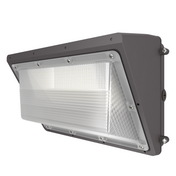
Quality LED area lights (shoebox lights) range from 100W to 500W and produce 15,000 to 75,000 lumens. HaroLux recommends these coverage estimates:
| Fixture Wattage | Typical Lumens | Approximate Coverage Area (sq ft) at 5 fc |
|---|---|---|
| 100W | 14,000 lm | ~4,000 sq ft |
| 200W | 28,000 lm | ~8,000 sq ft |
| 300W | 45,000 lm | ~12,000 sq ft |
Source: HaroLux 2026 LED parking lot light guide
A 300W LED shoebox light at 150 lm/W efficacy produces 45,000 lumens — equivalent to a 1000W metal halide fixture — while consuming 70% less energy and lasting 2.5 times longer.
Continuing the example — 30,000 sq ft office lot with 1.0 fc target, using 100W fixtures (14,000 lm each):
-
Total Lumens Required = 37,500 lm
-
Number of Fixtures = 37,500 ÷ 14,000 = 2.7 → 3 fixtures
Using 200W fixtures (28,000 lm each): 37,500 ÷ 28,000 = 2 fixtures.
Step 5: Factor in Pole Height — The Hidden Variable
Pole height dramatically affects how many fixtures you need. Taller poles allow each fixture to cover a wider area, reducing fixture count. However, taller poles require higher lumen output per fixture to maintain target light levels at ground level.
Typical Pole Height Ranges for Commercial Parking Lots
| Pole Height | Typical Applications | Typical Spacing | Approx. Coverage per Fixture |
|---|---|---|---|
| 12 – 15 ft | Small retail lots, apartment complexes | 30 – 40 ft apart | 900 – 1,600 sq ft |
| 16 – 25 ft | Shopping centers, schools, general commercial (most common) | 40 – 60 ft apart | 1,600 – 4,000+ sq ft |
| 25 – 40 ft | Large retail centers, distribution yards, stadium parking | 60 – 80+ ft apart | 4,000 – 12,000+ sq ft |
Sources: Pole height and spacing guidelines
Recommended Wattage by Pole Height
| Pole Height | Recommended LED Wattage | Target Lumens |
|---|---|---|
| 8 – 12 ft | 30 – 60W | 3,900 – 7,800 lm |
| 12 – 15 ft | 60 – 100W | 7,800 – 13,000 lm |
| 15 – 20 ft | 100 – 200W | 13,000 – 32,000 lm |
| 20 – 30 ft | 200 – 300W | 26,000 – 48,000 lm |
| 30 – 40 ft | 300 – 400W | 39,000 – 52,000 lm |
Source: Hylele LED parking lot light selection guide
Step 6: Understand Light Distribution (Type II, III, IV, V)
Distribution pattern determines how light spreads from the fixture. Choosing the right pattern is critical for uniform illumination.
| Distribution Type | Beam Shape | Best Application |
|---|---|---|
| Type II | Rectangular pattern up to 1:1.5 width‑to‑length ratio | Narrow roadways, parking lanes, walkways; fixtures spaced 2‑3× mounting height |
| Type III | Wider rectangular pattern up to 1:2 width‑to‑length ratio | Large parking lots where fixtures are placed near one side (perimeter lighting) |
| Type IV | 180° forward throw | Building perimeters, loading docks, edge‑of‑lot applications |
| Type V | Square or round symmetric | Center‑mounted poles in open areas |
Sources: Distribution pattern guide
For standard parking lots with poles in driving lanes, Type II provides optimal uniform coverage. For perimeter lighting where fixtures mount on building edges, Type III distributes light further into the space. Many shoebox lights offer interchangeable lenses so you can select the distribution pattern during installation.
Step 7: Use Spacing‑to‑Height Ratio (SHR) for Layout
Even with the correct number of fixtures, spacing them incorrectly creates dark spots. The Spacing‑to‑Height Ratio (SHR) ensures uniform coverage.
SHR = Spacing between fixtures ÷ Mounting height
For area lighting and parking lots, an SHR of 3:1 to 4:1 is typical. At 20‑foot mounting height, space fixtures 60‑80 feet apart.
General SHR guidelines by application:
| Application | Recommended SHR | At 20 ft Mounting Height |
|---|---|---|
| High‑bay industrial | 1.0 – 1.5 | 20 – 30 ft |
| Parking lot (Type II/III) | 3.0 – 4.0 | 60 – 80 ft |
| Street lighting | 3.0 – 4.0 | Varies by fixture type |
Source: General spacing guidelines
For a parking lot with 20‑foot poles:
-
Light poles should be spaced approximately 60 to 80 feet apart.
-
Pole spacing should not exceed 4 times the mounting height (80 ft) without risking dark spots between fixtures.
Step 8: Account for Light Loss Factor (LLF)
Many online calculators skip the Light Loss Factor — but that‘s a mistake. A fixture with 45,000 initial lumens will deliver only about 33,750 lumens at the pavement after 5‑7 years due to dust accumulation and LED lumen depreciation.
Recommended LLF for parking lots: 0.75 to 0.85. This means design for 25‑15% more lumens than the initial target.
For a 30,000 sq ft suburban lot with 1.0 fc target, skipping LLF would suggest 30,000 total lumens. With LLF = 0.80, the design needs 37,500 lumens — an extra fixture that ensures the lot stays adequately lit over time.
Real‑World Calculation Example — Comprehensive Walkthrough
Parking lot specifications:
-
Lot size: 200 ft × 150 ft = 30,000 sq ft
-
Use: Suburban retail center (medium traffic) — IES Zone 2: 1.0 fc target
-
Pole height: 20 feet
-
Light Loss Factor (LLF) = 0.80
-
Fixture choice: 100W LED shoebox light, 14,000 lumens, Type III distribution
Step 1 — Total lumens required:
Total Lumens = (30,000 × 1.0) ÷ 0.80 = 37,500 lumens
Step 2 — Number of fixtures:
Fixtures = 37,500 ÷ 14,000 = 2.7 → 3 fixtures minimum
Step 3 — Verify with coverage rule of thumb:
At 5 fc, a 100W fixture covers approximately 4,000 sq ft. For 1.0 fc, coverage increases to approximately 4,000 ÷ (5 × 1.0) = 20,000 sq ft.
30,000 sq ft ÷ 20,000 per fixture = 1.5 fixtures → 2‑3 fixtures (consistent with calculation)
Result: This parking lot requires 3 fixtures mounted at 20 feet, spaced approximately 60‑70 feet apart for uniform coverage.
HID‑to‑LED Replacement — A Shortcut
If you‘re retrofitting an existing parking lot with metal halide or HPS fixtures, you can use this wattage conversion guide instead of calculating from scratch:
| Legacy HID Fixture | Recommended LED Replacement | Lumens (approx.) |
|---|---|---|
| 100W HID | 30 – 40W LED | 3,900 – 5,200 lm |
| 250W HID | 80 – 100W LED | 10,400 – 13,000 lm |
| 400W HID | 120 – 150W LED | 15,600 – 19,500 lm |
| 750W – 1000W HID | 200 – 300W LED | 26,000 – 48,000 lm |
Source: HID‑to‑LED conversion guide
Why LLF Matters — The Hidden Cost of Skipping It
Let‘s compare two designs for a 50,000 sq ft suburban parking lot (1.0 fc target):
| Design Approach | Total Lumens Required | Fixtures (200W LED, 28,000 lm) | Light level after 7 years |
|---|---|---|---|
| Without LLF | 50,000 lm | 2 fixtures | Approximately 0.7‑0.8 fc (below target) |
| With LLF = 0.80 | 62,500 lm | 3 fixtures | ≥ 1.0 fc maintained |
The design that skips LLF saves one fixture upfront but creates a long‑term liability — dark spots that compromise security and increase accident risk. Always include LLF.
Professional Photometric Design — Why Calculation Isn‘t Enough
The formulas in this guide provide ballpark estimates. For final design and fixture selection, you need a photometric layout generated by AGi32, DIALux, or similar software.
A professional photometric design shows exact illuminance contours, uniformity ratios, glare analysis, and pole placement across your specific lot geometry — accounting for trees, buildings, pavement color, and surrounding structures.
Many reputable lighting suppliers offer free photometric layouts with fixture purchase — always request one before ordering.
Quick Reference Tables
Foot‑Candle Targets by Application
| Application | Target fc (average) |
|---|---|
| Rural / low‑traffic lot | 0.5 – 1.0 |
| Suburban / mid‑size commercial | 1.0 – 2.0 |
| Urban / retail center | 1.5 – 3.0 |
| High‑security (hospitals, transit) | 2.0 – 5.0 |
| Parking garage ramp | 10.0 |
| Parking garage entrance (day) | 50.0 |
Fixture Count Estimates by Lot Size
| Lot Size (sq ft) | Target fc | Fixture Wattage | Approx. Fixture Count |
|---|---|---|---|
| 10,000 | 1.0 fc | 100W | 2 – 3 |
| 20,000 | 1.0 fc | 150W | 3 – 4 |
| 50,000 | 1.5 fc | 200W | 6 – 8 |
| 100,000 | 2.0 fc | 300W | 12 – 16 |
These are estimates. Exact counts depend on pole height, distribution pattern, and LLF.
The FSG Warehouse Calculator Approach
While designed for warehouses, the FSG calculator approach uses a ceiling‑height‑adjusted Coefficient of Utilization (CU) — 0.55 for heights above 25 ft, 0.60 for 20‑25 ft, and 0.65 for under 20 ft — to reflect real‑world light loss in tall spaces. For parking lots, consult a lighting professional to determine appropriate CU values.
The full Lumen Method formula is:
Number of Fixtures = (Area × Target Foot‑Candles) ÷ (Lumens per Fixture × CU × LLF)
Where CU (Coefficient of Utilization) is the percentage of light that reaches the paved surface (typically 0.5‑0.7 for parking lots).
Energy Savings and ROI — Real Numbers
Switching from metal halide to LED parking lot lights typically delivers:
-
Energy savings: 50‑70% lower electricity bills
-
Maintenance savings: Near‑zero for 10‑15 years
-
Lifespan: 50,000‑100,000+ hours vs. 10,000‑20,000 for HID
-
Payback period: 1.5‑3 years, often under 18 months with DLC V6.0 utility rebates
Real‑world example — 20,000 sq ft lot with 250W HID replaced by 80W LED:
-
Annual energy savings per fixture: approximately 100 at $0.12/kWh
-
For 10 fixtures: 1,000 per year in energy savings alone
DLC V6.0 critical deadlines for 2026:
-
V5.1 fixtures removed from QPL: October 1, 2026
-
V5.1 final delisting: December 15, 2026
For any 2026 parking lot project, specify DLC V6.0 Premium certified fixtures to ensure full rebate eligibility.
Frequently Asked Questions (FAQ)
Q: How many foot‑candles does a commercial parking lot need?
A: For general commercial parking, 1‑2 fc is typical. For high‑activity retail or security‑sensitive areas, 2‑5 fc is recommended. IES RP‑20 specifies 0.5‑1.5 fc for rural/suburban and up to 3.0 fc for urban zones.
Q: How many lumens per square foot for parking lot lighting?
A: One foot‑candle equals one lumen per square foot. For a 1.0 fc target, you need 1 lumen per square foot before accounting for LLF. With LLF = 0.80, you need 1.25 lumens per square foot to maintain 1.0 fc over time.
Q: What is the correct spacing for parking lot lights?
A: For 20‑foot poles, space fixtures 60‑80 feet apart (SHR of 3:1 to 4:1). For 25‑foot poles, spacing increases to 75‑100 feet. Always confirm with a photometric layout.
Q: What is the best beam angle for parking lot lighting?
A: For typical 15‑20 ft pole heights with Type III distribution, medium‑wide beam angles (90°‑120°) provide balanced coverage. Taller poles (25+ ft) benefit from narrower beam angles to project light further.
Q: How many LED parking lot lights do I need for a 100×100 ft lot?
A: Approximately 2‑4 fixtures, depending on target fc and pole height. A 150W fixture on a 20‑ft pole typically covers 3,000‑5,000 sq ft at 1‑2 fc.
Final Summary
Calculating how many LED area lights your parking lot needs is an eight‑step process:
-
Determine target illuminance — 0.5‑3.0 fc for open lots (IES RP‑20)
-
Measure lot area — length × width
-
Set Light Loss Factor — 0.75‑0.85 for parking lots
-
Calculate total lumens required — (Area × Target fc) ÷ LLF
-
Choose fixture lumens — quality LEDs deliver 140+ lm/W
-
Divide to get fixture count — Total Lumens ÷ Lumens per Fixture
-
Verify spacing — SHR of 3:1 to 4:1 based on mounting height
-
Request a professional photometric design — confirm layout before ordering
Avoid common mistakes — don‘t skip LLF, don‘t guess spacing, don‘t ignore distribution type, and don‘t overlook DLC V6.0 certification for 2026 utility rebates.
Take action today: Measure your parking lot, calculate your target lumens, and contact a qualified lighting professional for a free photometric layout — before the December 15, 2026 DLC V5.1 delisting deadline.